Blocked Fallopian Tubes and Pregnancy: Can You Get Pregnant With One Blocked Tube?
✓ Reviewed by
Dr. Pooja Ghorpade
MD (Obstetrics & Gynecology) | IVF Consultant
Specialized IVF Training – National University Hospital (NUH), Singapore
19+ Years of Experience in Women’s Health & Fertility Care
Can You Get Pregnant With One Blocked Fallopian Tube?
💡 Quick Answer:
Yes, pregnancy may still be possible if one fallopian tube is blocked and the other tube is open and functional.
Fallopian tubes play an important role in natural conception because they provide the usual pathway where the egg and sperm can meet.
If one tube is blocked but the other tube is healthy, natural pregnancy may still occur. However, the chances depend on several factors, including age, ovulation, sperm health, the condition of the open tube, and the reason for the blockage.
If both fallopian tubes are completely blocked, natural conception is generally not possible because the egg and sperm cannot meet through the tubes. In such situations, fertility treatment such as IVF may be considered depending on the individual circumstances.
Most importantly, a blocked fallopian tube does not always cause symptoms. Some women discover tubal blockage only when they undergo fertility testing.
What Are Fallopian Tubes and Why Are They Important for Pregnancy?
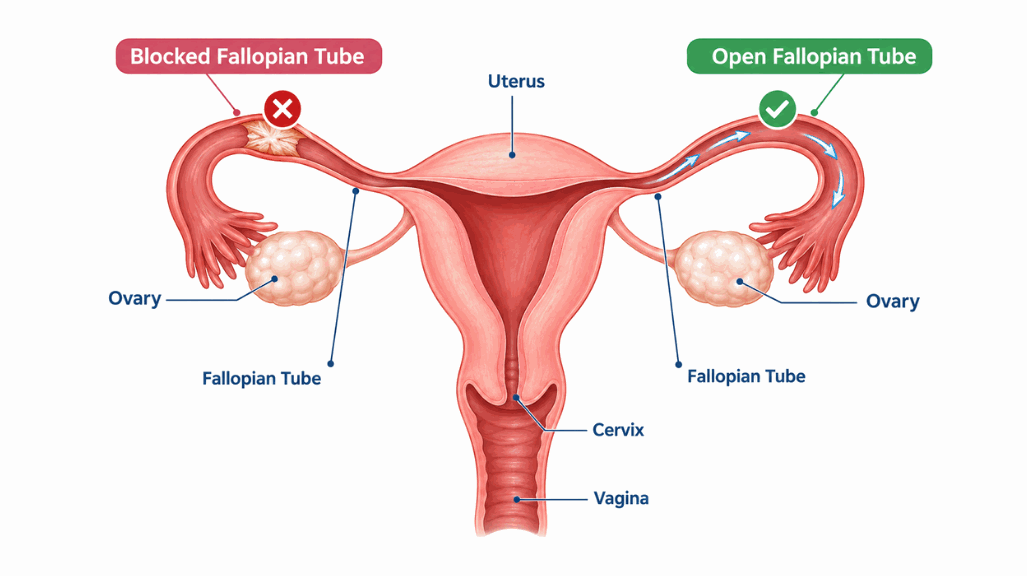
Fallopian tubes are two narrow tubes that connect the ovaries with the uterus.
During ovulation, an egg is released from an ovary. The fallopian tube helps provide the pathway for the egg.
In natural conception, sperm travel through the female reproductive tract and may meet the egg in the fallopian tube. If fertilisation occurs, the resulting embryo normally travels toward the uterus, where implantation can take place.
This is why the health and openness of the fallopian tubes can be important for natural pregnancy.
Can You Get Pregnant With One Blocked Fallopian Tube?
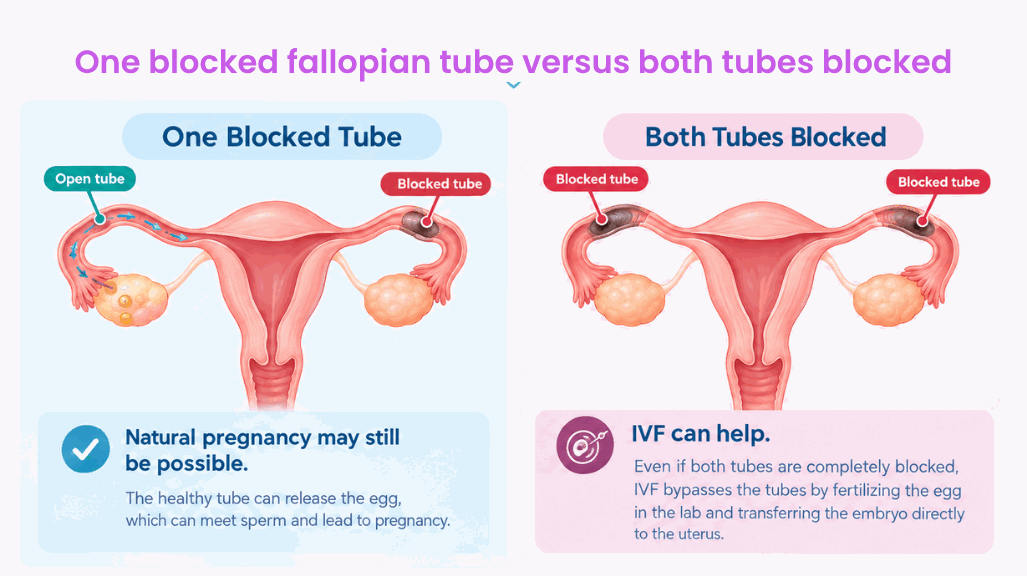
Yes, it can be possible. If one tube is blocked and the other tube is open and functional, pregnancy may occur naturally. However, having one open tube does not guarantee pregnancy — other fertility factors also matter.
| Situation | Natural Pregnancy Possible? |
|---|---|
| Both tubes open and healthy | Yes |
| One tube blocked, one tube open and functional | Yes, pregnancy may still be possible |
| Both tubes completely blocked | Natural pregnancy is generally not possible |
| Tubes damaged rather than completely blocked | Pregnancy may still be possible, but fertility can be affected |
The exact situation should be assessed individually rather than based only on the words “blocked tube” in a scan or report.
Does One Blocked Tube Reduce the Chance of Pregnancy?
It can.
When one tube is blocked, there is only one open pathway available for natural conception. The impact can vary depending on the location and severity of the blockage, the condition of the other tube, ovulation, age and other fertility factors.
It is therefore not correct to say that one blocked tube means pregnancy is impossible.
At the same time, it is also not correct to assume that an open tube guarantees pregnancy.
A fertility evaluation can help understand the complete picture.
What Are the Symptoms of Blocked Fallopian Tubes?
One important thing to know is:
Blocked fallopian tubes may not cause any obvious symptoms.
Many women with tubal blockage have regular periods and may not experience pain or other noticeable changes.
Sometimes symptoms may be related to the underlying condition that caused the blockage rather than the blockage itself.
Possible symptoms or associated problems can include:
- Difficulty becoming pregnant
- Pelvic pain in some conditions
- Painful periods in some women
- A history of pelvic infection
- Previous ectopic pregnancy
- Previous pelvic or abdominal surgery
- History of endometriosis
However, symptoms alone cannot confirm whether a fallopian tube is blocked.
Testing is usually needed to assess tubal patency.
What Causes Blocked Fallopian Tubes?
Several conditions can cause fallopian tube damage or blockage.
- Pelvic Infections
Certain pelvic infections, including sexually transmitted infections, can cause inflammation and scarring of the reproductive tract.
The resulting scar tissue may affect the fallopian tubes.
- Pelvic Inflammatory Disease
Previous pelvic inflammatory disease can damage the tubes and may lead to tubal-factor infertility.
- Endometriosis
Endometriosis can cause inflammation, scarring and adhesions around the reproductive organs, which may affect the fallopian tubes.
- Previous Pelvic or Abdominal Surgery
Some surgeries can result in adhesions or scar tissue around the reproductive organs.
- Previous Ectopic Pregnancy
An ectopic pregnancy involving a fallopian tube can damage the tube and may affect future fertility.
- Previous Tubal Surgery or Sterilisation
A previous procedure involving the fallopian tubes can affect their ability to allow an egg and sperm to meet.
A history of pelvic infection, endometriosis, ectopic pregnancy or pelvic surgery can increase suspicion for tubal-factor infertility.
How Do Doctors Check for Blocked Fallopian Tubes?
A fertility evaluation may include fertility testing to check whether the fallopian tubes are open.
HSG — Hysterosalpingography
HSG is an imaging test in which contrast is introduced through the uterus and X-ray imaging is used to assess the uterine cavity and whether the contrast passes through the fallopian tubes.
It is commonly used to assess tubal patency.
HyCoSy / Contrast Ultrasound
In some settings, a contrast-enhanced ultrasound technique may be used to assess whether the fallopian tubes are open.
Laparoscopy
Laparoscopy is a surgical procedure that may be used in selected situations. It is not routinely required for every woman simply to check whether the tubes are open. The appropriate test depends on the individual’s history and clinical situation.
Does a Positive HSG Result Always Mean the Tube Is Blocked?
Not necessarily.
The interpretation of tubal testing can sometimes be complicated, particularly when a blockage appears near the uterus.
For example, apparent proximal blockage can sometimes be related to temporary tubal or uterine muscle contractions or technical factors. Further evaluation may sometimes be needed before concluding that a tube is permanently blocked.
This is why it is important to discuss the complete test report and your medical history with a fertility specialist, rather than making decisions based on a single report.
What Happens If Both Fallopian Tubes Are Blocked?
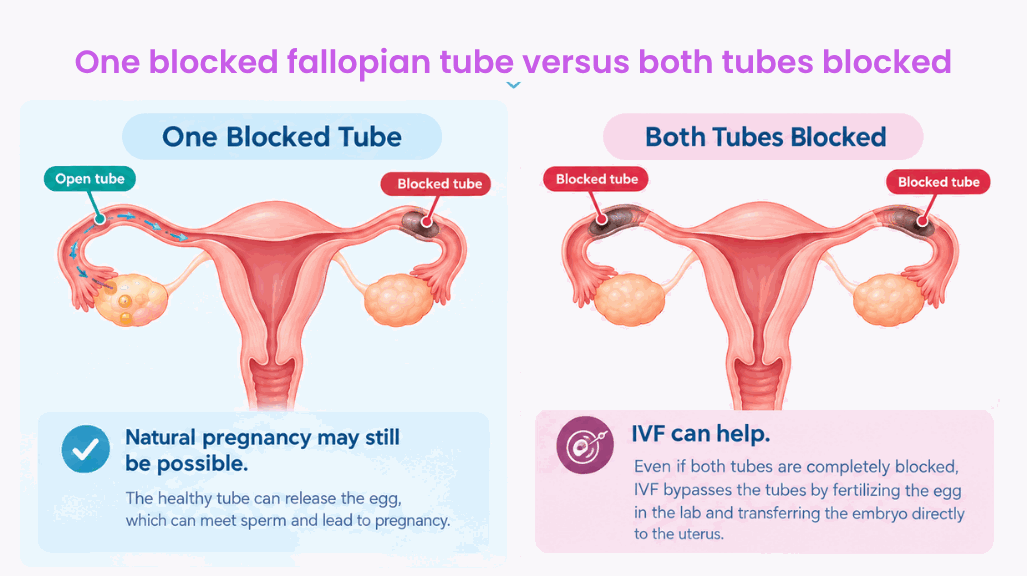
If both tubes are completely blocked, natural conception is generally not possible because the egg and sperm cannot meet through the fallopian tubes.
However, this does not mean pregnancy is impossible.
IVF treatment can bypass the fallopian tubes.
During IVF, eggs are collected from the ovaries and fertilised with sperm in a laboratory. The resulting embryo can then be transferred into the uterus.
Therefore:
Blocked tubes can make natural conception difficult or impossible, but they do not necessarily mean that you cannot become pregnant with fertility treatment.
The appropriate treatment depends on the type and location of the blockage, the condition of the tubes, age, ovarian reserve, sperm factors and other individual fertility factors.
Is IVF Needed If One Fallopian Tube Is Blocked?
Not necessarily.
If one tube is blocked and the other tube is open and functional, some women may be able to conceive naturally.
Whether to continue trying naturally, consider IUI, or move toward IVF depends on a complete fertility evaluation.
Doctors may consider factors such as:
- Age
- Duration of trying to conceive
- Ovulation
- Ovarian reserve
- Condition of the open fallopian tube
- Sperm count and motility
- Endometriosis
- Previous pregnancy history
- Other fertility problems
A blocked tube should therefore be considered as one part of the fertility picture, not the only factor.
What If the Open Tube Is Also Damaged?
An important distinction is that a tube can be open but not completely healthy.
Tubal damage or scarring may interfere with the normal movement of the egg or embryo.
In some cases, damaged tubes can also increase the risk of an ectopic pregnancy, where a pregnancy develops outside the uterus, most commonly in a fallopian tube.
This is one reason why fertility treatment decisions should be based on the condition of the tubes, not simply whether a report says “open.”
Can Blocked Fallopian Tubes Be Treated?
Treatment depends on where the blockage is, why it happened, whether one or both tubes are affected, and the overall fertility situation.
Depending on the circumstances, options may include:
- Further evaluation to confirm the blockage
- Treatment of an underlying infection or condition
- Selected procedures to treat certain types of tubal obstruction
- Tubal surgery in carefully selected patients
- IVF when appropriate
Not every blocked tube needs surgery.
For some patients, IVF may be a more suitable option than attempting to repair severely damaged tubes.
The decision should be individualised by a fertility specialist.
Can Blocked Fallopian Tubes Be Prevented?
Not every cause of tubal blockage can be prevented.
However, protecting reproductive health and seeking timely treatment for pelvic infections can be important.
If you have:
- A history of pelvic infection
- Previous ectopic pregnancy
- Previous pelvic surgery
- Endometriosis
- Previous tubal surgery
it is useful to discuss your fertility history with your doctor, especially if you are planning pregnancy.
Myth vs Fact: Blocked Fallopian Tubes
| Myth | Fact |
|---|---|
| One blocked tube means pregnancy is impossible. | Pregnancy may still be possible if the other tube is open and functional. |
| Blocked tubes always cause pain. | Tubal blockage may have no obvious symptoms. |
| Regular periods mean the tubes are definitely open. | Regular periods do not confirm tubal patency. |
| Both blocked tubes mean pregnancy is impossible. | Natural conception is generally not possible with complete bilateral blockage, but IVF may bypass the tubes. |
| Every blocked tube needs surgery. | Treatment depends on the location, severity, cause and overall fertility situation. |
| An HSG report alone gives the complete fertility picture. | Fertility evaluation also considers ovulation, ovarian factors, sperm health and other reproductive factors. |
When Should You See a Fertility Specialist?
Consider a fertility evaluation if you have been trying to conceive without success, particularly if you have a history that could affect the fallopian tubes.
An evaluation may be appropriate sooner if there is:
- Known or suspected tubal disease
- Previous ectopic pregnancy
- Previous pelvic infection
- Endometriosis
- Previous pelvic surgery
- Known male-factor fertility concerns
ASRM recommends earlier evaluation when there is a known condition associated with infertility rather than always waiting for the usual timeframe.
For women without a known fertility problem, evaluation is generally recommended after 12 months of trying if under 35, or after 6 months if 35 or older. More immediate evaluation may be appropriate after age 40.
What Should You Do If You Have a Blocked Fallopian Tube?
If a report says that one or both fallopian tubes are blocked, try not to assume that pregnancy is impossible.
Instead, discuss:
- Is the blockage in one tube or both?
- Where exactly is the blockage?
- Is the other tube open and functional?
- Could the test result need confirmation?
- Are there signs of endometriosis, infection or previous tubal damage?
- Is ovulation occurring normally?
- Does the male partner need a semen analysis?
- Would natural conception, IUI, surgery or IVF be more appropriate?
A complete fertility evaluation helps determine the next step rather than focusing on the tube blockage alone.
Can You Still Become a Mother With a Blocked Tube?
Yes.
A blocked fallopian tube can affect fertility, but it does not automatically mean that pregnancy is impossible.
If one tube is blocked and the other is open and functional, natural pregnancy may still occur.
If both tubes are completely blocked, IVF can provide a way to bypass the fallopian tubes.
The right approach depends on your age, reproductive history, ovarian function, sperm health, tubal condition and other fertility factors.
The important thing is to get the blockage properly evaluated and understand your options.
Key Takeaways
- ✓ Fallopian tubes play an important role in natural conception.
- ✓ One blocked tube does not automatically mean you cannot get pregnant.
- ✓ Pregnancy may still be possible if the other tube is open and functional.
- ✓ Blocked fallopian tubes may not cause symptoms.
- ✓ Regular periods do not confirm that the tubes are open.
- ✓ HSG and other tubal-patency tests can help evaluate the fallopian tubes.
- ✓ Both completely blocked tubes generally prevent natural conception.
- ✓ IVF treatment can bypass the fallopian tubes.
- → Not every blocked tube requires surgery.
- → Your fertility treatment should be based on your complete fertility evaluation, not just one test result.
Frequently Asked Questions About Blocked Fallopian Tube
1. Can I get pregnant naturally with one blocked fallopian tube? ▼
Yes. If the other fallopian tube is open and functional, natural pregnancy may still be possible.
2. Can blocked fallopian tubes cause infertility? ▼
Yes. Tubal disease is an important cause of infertility because blockage or damage can interfere with the meeting of the egg and sperm.
3. Do blocked fallopian tubes always cause symptoms? ▼
No. Some women have no noticeable symptoms and discover tubal blockage during fertility testing.
4. How do I know if my fallopian tubes are blocked? ▼
Tests such as HSG or contrast-based ultrasound techniques can be used to assess whether the tubes are open.
5. Can I get pregnant if both tubes are blocked? ▼
Natural conception is generally not possible when both fallopian tubes are completely blocked. However, IVF can bypass the tubes and may provide a route to pregnancy.
6. Is IVF the only option for blocked tubes? ▼
Not always. Treatment depends on whether one or both tubes are affected, the location and severity of blockage, age, other fertility factors and the overall clinical situation.
7. Can a blocked fallopian tube be opened? ▼
Some types of tubal obstruction may be treated with procedures or surgery, but not every blockage is suitable for repair. A fertility specialist can determine the appropriate option.
8. Can regular periods happen with blocked fallopian tubes? ▼
Yes. Tubal blockage does not necessarily stop ovulation or periods.
9. Can a blocked tube increase the risk of ectopic pregnancy? ▼
Tubal damage can increase the risk of ectopic pregnancy. If you become pregnant and have significant one-sided pelvic pain or bleeding, prompt medical evaluation is important.
10. Should I see a fertility specialist if I have one blocked tube? ▼
It can be helpful, particularly if you have been trying to conceive, have other fertility concerns, or have a history of ectopic pregnancy, pelvic infection, endometriosis or pelvic surgery.
For answers to other common fertility questions, visit our fertility FAQs.
About Orchid IVF Center, Kolhapur
Orchid IVF Center, Kolhapur provides fertility evaluation and treatment for individuals and couples experiencing difficulties with conception.
Under the guidance of Dr. Pooja Ghorpade, MD (Obstetrics & Gynecology) and IVF Consultant, fertility concerns can be evaluated based on the individual’s medical history, reproductive factors and fertility needs.
If you have been told that you have a blocked fallopian tube, a proper fertility evaluation can help you understand what the finding means and what options may be available to you.
✓ Dr. Pooja Ghorpade
MD (Obstetrics & Gynecology) | IVF Consultant
Trained at I.V.F. N.U.H., Singapore
You can also explore more fertility and pregnancy articles on the Orchid IVF blog.
Contact Orchid IVF Center
📍 202, Second Floor, Eternity Square,
Opp. RTO Office,
Tarabai Park, Kolhapur
