What Happens After a Positive IVF Pregnancy Test? First 8 Weeks After IVF Explained

✓ Reviewed by
Dr. Pooja Ghorpade
MD (Obstetrics & Gynecology) | IVF Consultant
Specialized IVF Training – National University Hospital (NUH), Singapore
19+ Years of Experience in Women’s Health & Fertility Care
What Happens After a Positive IVF Pregnancy Test?
💡 Quick Answer:
A positive pregnancy test after IVF is an important milestone, but it is only the beginning of early pregnancy monitoring.
After a positive test, your fertility team will usually monitor beta-hCG levels, review medications and arrange an early ultrasound at the appropriate time to confirm the pregnancy location and assess early development.
The first several weeks can feel both exciting and stressful because symptoms may vary significantly from one woman to another.
After IVF, you may experience symptoms such as fatigue, breast tenderness, mild cramping, nausea or no symptoms at all. The presence or absence of pregnancy symptoms does not by itself confirm whether the pregnancy is progressing normally.
The first 8 weeks are therefore focused on monitoring early pregnancy development and providing appropriate medical support.
Is a Positive Pregnancy Test After IVF a Confirmed Pregnancy?
A positive pregnancy test means that hCG (human chorionic gonadotropin) has been detected.
However, your fertility team will usually need additional monitoring to understand how the pregnancy is progressing.
The next steps may include:
Positive Pregnancy Test → Beta-hCG Monitoring → Early Ultrasound → Confirmation of Pregnancy Development
Depending on the treatment and your individual circumstances, your doctor may recommend repeat blood tests and an ultrasound at a suitable stage.
What Is Beta-HCG After IVF?
Beta-hCG is a hormone produced after implantation begins.
It is commonly measured through a blood test during early pregnancy.
After IVF, your fertility team may recommend checking beta-hCG after the expected time following embryo transfer.
A repeat test may sometimes be recommended to assess how the level is changing over time.
However, one beta-hCG number does not tell the entire story.
Doctors interpret the result based on:
- The timing of the test
- Embryo transfer date
- Previous beta-hCG result
- Clinical symptoms
- Ultrasound findings
Your doctor will decide when further testing is appropriate.
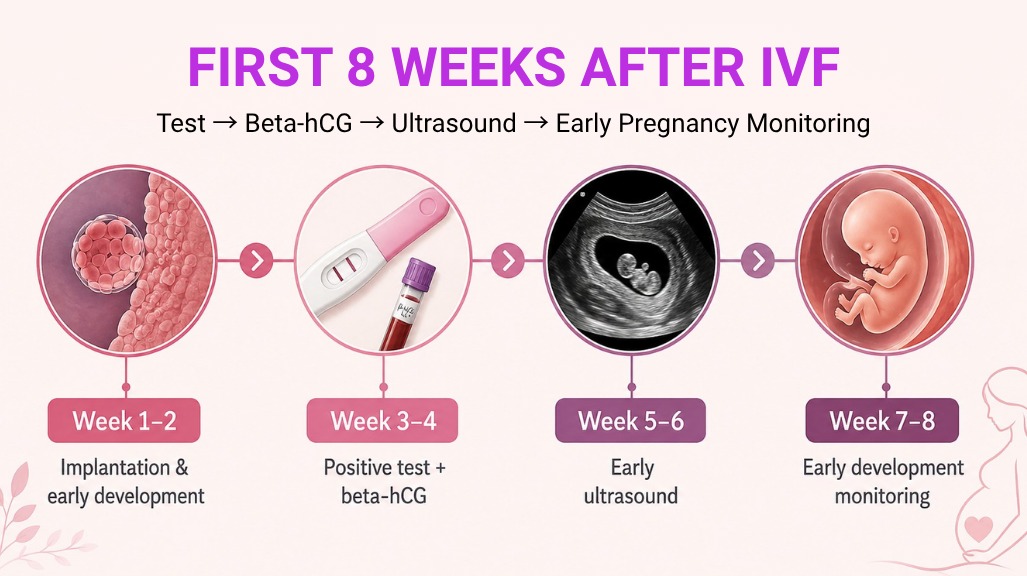
First 8 Weeks After IVF: What to Expect
Week 1–2 After Embryo Transfer
At this stage, the embryo may be undergoing implantation and early development.
You may experience:
- Mild cramping
- Breast tenderness
- Fatigue
- Bloating
- No noticeable symptoms
Some symptoms may also be related to progesterone or other medications used during fertility treatment.
Therefore, symptoms alone cannot tell you whether implantation has occurred.
Important
Continue medications exactly as prescribed by your fertility team unless your doctor tells you otherwise.
Week 3–4: Positive Pregnancy Test and Beta-hCG
This is often the stage when couples receive their positive pregnancy test.
Your fertility team may recommend a beta-hCG blood test and, depending on the result and clinical situation, a repeat test.
At this stage, you may experience:
- Fatigue
- Breast tenderness
- Nausea
- Increased urination
- Mild abdominal discomfort
- Mood changes
Some women may have very few symptoms.
That can also be normal.
Remember
Pregnancy symptoms vary from woman to woman.
Do not compare your symptoms with another woman’s IVF pregnancy.
Week 5: Early Pregnancy Development
Around this stage, an early pregnancy ultrasound may be planned depending on your individual circumstances and the timing of your IVF treatment.
The purpose of an early scan is to assess the pregnancy and determine whether it is developing in the expected location.
You may begin experiencing more noticeable symptoms such as:
- Morning sickness
- Food aversions
- Fatigue
- Breast tenderness
- Increased urination
But again, symptoms are not a reliable measure of pregnancy progression.
Week 6: Early Ultrasound
Around the sixth week of pregnancy, an ultrasound may provide important information about early pregnancy development.
Depending on the exact gestational age and development, the scan may help assess:
- Pregnancy location
- Gestational sac
- Yolk sac
- Embryonic development
- Cardiac activity when visible
The exact timing at which these findings become visible can vary.
If cardiac activity is not visible on an early scan, it does not automatically mean that the pregnancy is not viable. Your doctor may recommend a repeat scan depending on the findings and gestational age.
Week 7: Monitoring Early Development
By around the seventh week, the pregnancy may become easier to assess on ultrasound.
Your doctor may evaluate:
- Embryo growth
- Cardiac activity
- Pregnancy location
- Overall early development
Symptoms such as nausea, fatigue and breast tenderness may continue.
Some women experience strong symptoms, while others experience very few.
Both experiences can occur in normal pregnancies.
Week 8: Preparing for Ongoing Pregnancy Care
By around eight weeks, your fertility team may have gathered more information about the pregnancy’s early development.
If the pregnancy is progressing appropriately, your doctor will discuss the next stage of antenatal care.
This may include:
- Continuing prescribed medications
- Routine pregnancy investigations
- Nutritional guidance
- Pregnancy supplements
- Planning future scans
- Transitioning from fertility-focused monitoring to routine obstetric care when appropriate
The exact timing varies from patient to patient.
What Medications Are Continued After IVF?
Some women are prescribed hormonal support after embryo transfer and early pregnancy.
This may include progesterone or other medications depending on the type of IVF cycle and individual clinical circumstances.
Do not stop prescribed fertility medications on your own after receiving a positive pregnancy test.
Your fertility specialist will tell you:
- Which medications to continue
- How long to continue them
- When they should be reduced or stopped
- Whether any medication needs to be changed
What Pregnancy Symptoms Are Common After IVF?
Early pregnancy symptoms can include:
😴 Fatigue
Hormonal changes can cause significant tiredness.
💗 Breast Tenderness
Hormonal changes may make the breasts feel sore or sensitive.
🤢 Nausea
Nausea and vomiting can begin during early pregnancy, although not every woman experiences them.
🚻 Increased Urination
Hormonal and circulatory changes can increase the need to urinate.
🤰 Mild Cramping
Mild abdominal or pelvic discomfort can occur during early pregnancy.
✨ No Symptoms
Some women have very few symptoms during early pregnancy.
Important: Not having morning sickness does not automatically mean something is wrong. Symptom levels vary widely from one pregnancy to another.
What About Bleeding After a Positive IVF Test?
Bleeding during early pregnancy should not simply be ignored.
Light spotting can occur in some pregnancies, but bleeding can also be associated with pregnancy complications.
If you experience:
- Heavy bleeding
- Severe abdominal pain
- Increasing pelvic pain
- Dizziness or fainting
- Shoulder-tip pain
- Significant weakness
contact your fertility or pregnancy care team promptly or seek urgent medical assessment.
Do not try to determine the cause based only on symptoms.
Can Ectopic Pregnancy Happen After IVF?
Yes.
Although IVF involves placing an embryo inside the uterus, ectopic pregnancy can still occur.
An ectopic pregnancy occurs when a pregnancy develops outside the normal cavity of the uterus, most commonly in a fallopian tube.
This is one reason early pregnancy monitoring after IVF is important.
Seek urgent medical attention if you develop severe abdominal or pelvic pain, significant bleeding, dizziness, fainting or other concerning symptoms.
What Should You Eat After a Positive IVF Pregnancy Test?
There is no special “IVF pregnancy diet” that guarantees a successful pregnancy.
Instead, focus on a balanced pregnancy diet that provides:
- Protein
- Whole grains
- Fruits
- Vegetables
- Calcium-rich foods
- Iron-rich foods
- Healthy fats
- Adequate fluids
Your doctor may also recommend pregnancy supplements such as folic acid and other nutrients based on your individual needs.
Avoid alcohol and smoking, and discuss caffeine intake and any supplements or herbal products with your doctor.
What Should You Avoid After IVF Pregnancy?
After a positive IVF pregnancy test, avoid making major lifestyle decisions based on advice from social media or unverified fertility forums.
In particular:
- Do not stop prescribed medication without medical advice.
- Do not start supplements without discussing them with your doctor.
- Avoid alcohol and smoking.
- Follow food-safety recommendations during pregnancy.
- Avoid activities that your doctor has specifically advised against.
- Do not compare your pregnancy symptoms with another IVF patient.
Normal daily activity is generally individualized according to your health and your doctor’s advice.
Can I Work After a Positive IVF Pregnancy Test?
In many uncomplicated pregnancies, women can continue normal daily activities and work.
However, your individual recommendations may depend on:
- Your medical history
- Type of fertility treatment
- Pregnancy complications
- Nature of your work
- Any symptoms you are experiencing
There is no universal rule that every woman with an IVF pregnancy must remain on bed rest.
Follow the activity advice provided by your treating doctor.
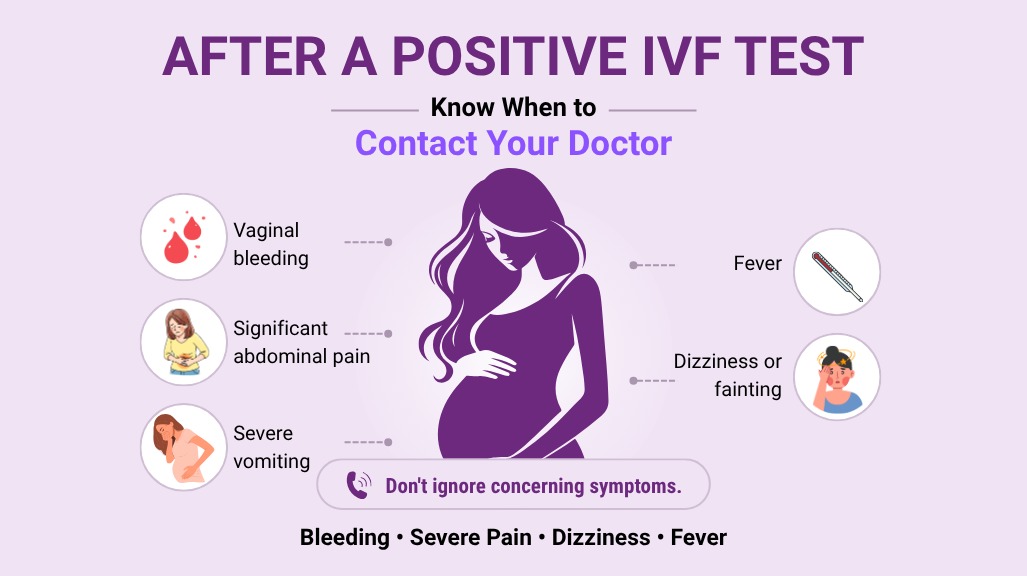
When Should You Contact Your Doctor?
Contact your fertility or pregnancy care team if you have concerns about:
- Vaginal bleeding
- Significant abdominal pain
- Severe vomiting
- Fever
- Dizziness or fainting
- Sudden worsening symptoms
- Any symptom that feels unusual or concerning
Emergency symptoms should be assessed promptly rather than waiting for a scheduled appointment.
What Happens After the First 8 Weeks?
Once early pregnancy development has been appropriately assessed, your care gradually moves toward routine antenatal pregnancy care.
Your doctor will guide you regarding:
- Pregnancy blood tests
- Ultrasound schedule
- Folic acid and other supplements
- Nutrition
- Screening tests
- Genetic screening where appropriate
- Ongoing obstetric care
The exact schedule depends on your pregnancy and medical history.
A Positive IVF Test Is a Milestone — Not the End of Monitoring
After months or years of fertility treatment, seeing a positive pregnancy test can bring enormous relief.
It is natural to feel excited and anxious at the same time.
Remember that the early weeks are about careful monitoring, appropriate medication and gradual confirmation of pregnancy development.
You do not need to understand every test or symptom on your own.
Stay in contact with your fertility team and follow the treatment plan provided for you.
Key Takeaways
- A positive IVF pregnancy test is an important milestone, but early monitoring is still needed.
- Beta-hCG testing may be used to assess early pregnancy.
- Ultrasound helps confirm pregnancy location and early development.
- Pregnancy symptoms vary significantly between women.
- Lack of symptoms does not automatically indicate a problem.
- Continue prescribed medications unless your doctor advises otherwise.
- Bleeding or significant pain should be discussed promptly with your doctor.
- Ectopic pregnancy can occur after IVF, making early monitoring important.
- After early pregnancy is appropriately established, care generally transitions toward routine antenatal care.
About Orchid IVF Center, Kolhapur
A positive IVF pregnancy test can bring happiness, relief and many new questions.
At Orchid IVF Center, Kolhapur, patients can receive guidance through the early stages of pregnancy following fertility treatment, with monitoring based on their individual medical needs.
✓ Dr. Pooja Ghorpade
MD (Obstetrics & Gynecology) | IVF Consultant
Trained at I.V.F. N.U.H., Singapore
Frequently Asked Questions About Positive IVF Pregnancy
1. What happens after a positive IVF pregnancy test? ▼
Your fertility team may arrange beta-hCG testing, review your medications and schedule an early ultrasound to assess pregnancy location and development.
2. When is the first ultrasound after IVF? ▼
The timing varies depending on the embryo transfer date, beta-hCG results and individual circumstances. Your fertility specialist will recommend the appropriate timing.
3. Is it normal to have no pregnancy symptoms after IVF? ▼
Yes. Pregnancy symptoms vary significantly. Some women have strong symptoms, while others have few or none during early pregnancy.
4. Should I stop progesterone after a positive IVF pregnancy test? ▼
Do not stop prescribed progesterone or other fertility medications on your own. Your fertility specialist will tell you when and how medications should be continued or changed.
5. Is bleeding normal after a positive IVF test? ▼
Light spotting can occur during early pregnancy, but bleeding should be discussed with your doctor. Heavy bleeding or bleeding accompanied by significant pain requires prompt medical assessment.
6. Can ectopic pregnancy happen after IVF? ▼
Yes. Ectopic pregnancy can occur after IVF, which is one reason early pregnancy monitoring and ultrasound are important.
7. When does IVF pregnancy become more like a normal pregnancy? ▼
Once early pregnancy development has been appropriately assessed, care generally transitions toward routine antenatal pregnancy care. The timing varies according to individual circumstances.
Contact Orchid IVF Center
📍 202, Second Floor, Eternity Square,
Opp. RTO Office,
Tarabai Park, Kolhapur
