How Many IVF Embryos Should Be Transferred? Single vs Multiple Transfer
Reviewed by
Dr. Puja Ghorpade
MD (Obstetrics & Gynecology) | IVF Consultant
- 🎓 Specialized IVF Training – National University Hospital (NUH), Singapore
- 🩹 19+ Years of Experience in Women’s Health & Fertility Care
- 📋 Medical Registration No.: MMC 2000072486
How Many IVF Embryos Should Be Transferred?
💡 Quick Answer:
The number of embryos transferred during IVF depends on several factors, including the woman’s age, embryo quality, previous IVF history, number of available embryos, medical history and the risk of multiple pregnancy.
While transferring more than one embryo may appear to increase the chance of pregnancy in some situations, it can also increase the chance of a multiple pregnancy, including twins or higher-order pregnancies, which carry additional maternal and fetal risks.
For many patients, transferring one embryo at a time can provide a good balance between achieving pregnancy and reducing the risks associated with multiple pregnancy. However, the appropriate number should always be decided with your fertility specialist based on your individual circumstances.
What Is Embryo Transfer in IVF?
Embryo transfer is the stage of IVF in which an embryo created in the laboratory is placed inside the uterus.
The process generally involves:
Egg Retrieval → Fertilization → Embryo Development → Embryo Transfer → Implantation → Pregnancy
Embryo transfer is usually performed using a thin catheter passed through the cervix into the uterus.
The number of embryos transferred is an important treatment decision because it can influence both the chance of pregnancy and the chance of multiple pregnancy.
What Is Single Embryo Transfer?
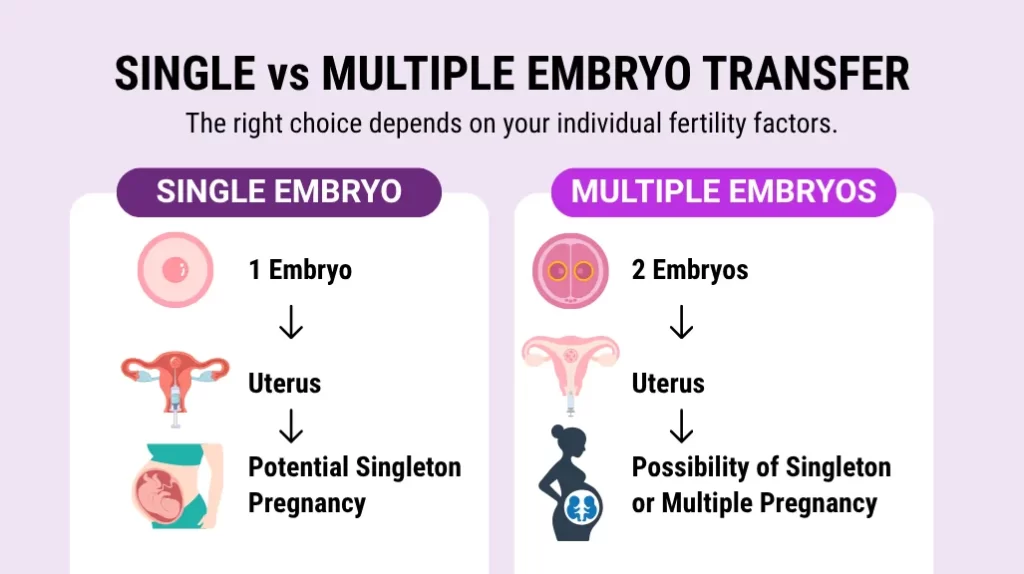
Single embryo transfer (SET) means that one embryo is transferred into the uterus during an IVF cycle.
The aim is to achieve a healthy singleton pregnancy while minimizing the risk of twins or higher-order multiple pregnancy.
With modern IVF techniques and appropriate embryo selection, transferring one embryo can be an effective approach for many patients.
Importantly, single embryo transfer does not mean that pregnancy is less likely in every situation. The expected outcome depends on factors such as embryo quality, age and the patient’s overall fertility profile.
What Is Multiple Embryo Transfer?
Multiple embryo transfer means transferring more than one embryo during the same IVF cycle.
For example:
- Two embryos
- Occasionally more than two, depending on the individual circumstances and applicable clinical guidance
The rationale may be to increase the chance that at least one embryo implants.
However, when more than one embryo implants, there is a greater possibility of a multiple pregnancy.
This is why transferring multiple embryos is not simply a question of “more embryos = better chances.”
Single vs Multiple Embryo Transfer
| Factor | Single Embryo Transfer | Multiple Embryo Transfer |
|---|---|---|
| Embryos transferred | One | More than one |
| Main aim | Singleton pregnancy | Increase opportunity for implantation in selected situations |
| Twin pregnancy risk | Lower | Higher |
| Higher-order multiple pregnancy | Very low | Higher |
| Pregnancy-related risks | Lower compared with multiple pregnancy | Higher when multiple pregnancy occurs |
| Decision | Based on individual factors | Based on individual factors |
| Suitable for | Many patients, depending on age/embryo factors | Selected patients when clinically appropriate |
The choice should be individualized rather than based solely on the number of embryos available.
Does Transferring Two Embryos Increase IVF Success?
This is one of the most common questions couples ask.
The answer is not as simple as yes or no.
Transferring two embryos can increase the chance that at least one embryo implants in some circumstances, but it also increases the chance that both embryos implant, resulting in twins or a higher-order multiple pregnancy.
Therefore, doctors consider the overall balance between:
Chance of pregnancy + Chance of multiple pregnancy + Maternal and fetal safety
The goal of IVF is not simply to achieve a positive pregnancy test.
The ultimate goal is a healthy pregnancy and healthy baby.
Why Are Multiple Pregnancies a Concern?
Twin and higher-order pregnancies can carry greater risks than singleton pregnancies.
Multiple pregnancy may increase the likelihood of complications such as:
- Preterm birth
- Low birth weight
- Pregnancy-related hypertension
- Gestational diabetes
- Caesarean delivery
- Neonatal intensive care
The risks vary depending on the type of multiple pregnancy and individual maternal and fetal factors.
For this reason, modern fertility treatment increasingly emphasizes single healthy pregnancy rather than simply maximizing the number of embryos transferred.
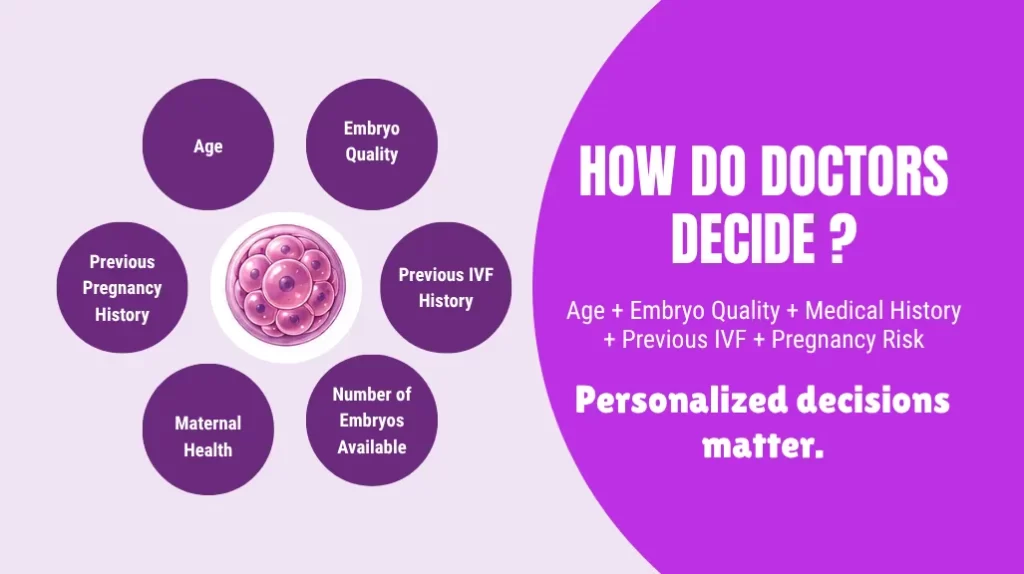
What Factors Determine How Many Embryos Should Be Transferred?
There is no universal number that is appropriate for every IVF patient.
Your fertility specialist may consider several factors.
1. Age
Age is an important factor in IVF treatment because embryo implantation potential and chromosomal factors change with increasing maternal age.
The appropriate embryo transfer strategy may therefore differ between younger and older patients.
2. Embryo Quality
Embryos differ in their developmental potential.
Your fertility team may consider:
- Embryo development
- Embryo stage
- Morphological grading
- Whether the embryo has undergone appropriate testing, when indicated
A higher-quality embryo may influence the decision to transfer a single embryo.
3. Number of Embryos Available
If several suitable embryos are available, a doctor may recommend transferring one embryo and preserving additional suitable embryos for future use where appropriate.
This can allow patients to have another opportunity without necessarily transferring multiple embryos in one cycle.
4. Previous IVF History
Previous IVF outcomes can also influence treatment planning.
Your doctor may consider:
- Previous embryo transfers
- Implantation history
- Pregnancy history
- Previous IVF outcomes
- Number and quality of embryos available
5. Previous Pregnancy and Live-Birth History
Your previous reproductive history may also influence the discussion.
A patient who has already achieved pregnancy may have different considerations from someone who has experienced repeated unsuccessful embryo transfers.
6. Uterine and Maternal Health
The mother’s overall health and uterine condition are important.
Conditions that may increase pregnancy risk can influence the decision to avoid multiple pregnancy.
Why Don’t Doctors Simply Transfer More Embryos?
Because more embryos do not automatically mean a better overall outcome.
Imagine two embryos are transferred and both implant.
The result may be a twin pregnancy.
While many twins are born healthy, twin pregnancy has a higher risk of complications compared with singleton pregnancy.
Therefore, fertility specialists must consider not just the probability of pregnancy, but also the safety of the pregnancy.
Can One Embryo Still Result in Twins?
Yes, although it is uncommon.
A single embryo can occasionally divide into two embryos, resulting in identical twins.
Therefore, single embryo transfer reduces the risk of multiple pregnancy but does not completely eliminate it.
What Happens to the Other Embryos?
If additional suitable embryos are available and are appropriate for cryopreservation, they may be frozen for future use.
This can provide another opportunity for embryo transfer without requiring another egg-retrieval procedure in every case.
Your fertility specialist will explain whether embryo freezing is appropriate for you.
Fresh vs Frozen Embryo Transfer: Does It Affect the Number of Embryos?
Fresh and frozen embryo transfer refer to when the embryo is transferred, not necessarily how many embryos are transferred.
Fresh Embryo Transfer
The embryo is transferred during the same overall treatment cycle after egg retrieval and fertilization.
Frozen Embryo Transfer
A previously frozen embryo is thawed and transferred during a later cycle.
In both situations, the number of embryos transferred is an independent treatment decision.
Is Single Embryo Transfer Always Better?
It would be incorrect to say that single embryo transfer is automatically the right choice for every patient.
The decision depends on:
- Age
- Embryo quality
- Previous IVF history
- Number of embryos available
- Previous pregnancy outcomes
- Medical history
- Risk associated with multiple pregnancy
- Applicable professional guidance
Your fertility specialist should explain the potential benefits and risks before the embryo transfer.
What Should Couples Ask Before Embryo Transfer?
Before your IVF embryo transfer, consider asking your fertility specialist:
How many embryos do you recommend transferring and why?
Understanding the reasoning is more important than simply knowing the number.
What is the quality and developmental stage of my embryo?
Ask how your embryo has developed and what the grading means.
What is my estimated chance of pregnancy?
Your doctor can explain the factors affecting your individual chances.
What is my risk of twins or multiple pregnancy?
This is especially important if more than one embryo is being considered.
What happens to the remaining embryos?
Ask whether suitable embryos can be frozen for future use.
Would single embryo transfer be appropriate for me?
This helps you understand whether a single embryo approach is reasonable based on your circumstances.
Is the Goal of IVF Pregnancy or a Healthy Baby?
💡 Quick Answer:
This is perhaps the most important point for couples to understand.
The objective of fertility treatment should not simply be:
“How can we get the highest possible pregnancy rate?”
The broader goal is:
“How can we achieve a healthy pregnancy with the lowest reasonable risk?”
This is why embryo transfer decisions require careful medical judgment.
Key Takeaways
- There is no single number of embryos that is right for every IVF patient.
- Single embryo transfer can reduce the risk of twins and higher-order multiple pregnancy.
- Multiple embryo transfer may be considered in selected circumstances.
- Age, embryo quality, previous IVF history and maternal health can influence the decision.
- Transferring more embryos does not automatically mean a better overall outcome.
- Additional suitable embryos may be frozen for future transfer.
- The goal of IVF should be a healthy pregnancy and healthy baby, not simply a positive pregnancy test.
- Discuss the benefits and risks of your individual embryo transfer strategy with your fertility specialist.
Frequently Asked Questions About IVF Embryos Transfer
1. Why are injections used during IVF?
IVF injections may stimulate follicle development, help control ovulation timing or support final egg maturation before egg retrieval. The purpose depends on the medication prescribed.
2. Does every IVF patient need injections?
Not necessarily the same injections. Many conventional IVF protocols involve injectable medications, but the medication plan varies according to the treatment protocol and the patient’s clinical needs.
3. Are all IVF injections used for the same purpose?
No. Different medications perform different roles during treatment. Some support follicle development, while others help manage ovulation timing or prepare eggs for retrieval.
4. Can IVF medication plans differ between patients?
Yes. Factors such as ovarian reserve, age, medical history, previous treatment response and the selected protocol influence the medication plan.
5. What should I do if I am worried about IVF injections?
Discuss your concerns with your fertility specialist or clinical team. Ask about the purpose of the medications, possible side effects and what support is available during treatment.
6. Can I change my IVF medication schedule myself?
No. Do not change, skip or repeat a dose without advice from your treating team. Contact your clinic if you miss a dose or are unsure about the timing.
7. How many injections are required during IVF?
There is no fixed number for every patient. The number and duration depend on the prescribed protocol, the medications used and how the ovaries respond to treatment.
8. Are IVF injections and ICSI injections the same?
No. IVF injections usually refer to medications given to the patient during treatment. ICSI, or intracytoplasmic sperm injection, is a laboratory procedure in which a single sperm is injected directly into an egg. It is a different process.
Dr. Puja Ghorpade
MD (OBST. & GYN.)
IVF Consultant
Orchid IVF Center
- Location: Tarabai Park, Kolhapur
- Phone: 7822057245
- Website: www.orchidivf.in
