Why Is My Period Regular but I Am Not Getting Pregnant? 7 Possible Reasons

✓ Reviewed by
Dr. Pooja Ghorpade
MD (Obstetrics & Gynecology) | IVF Consultant
Specialized IVF Training – National University Hospital (NUH), Singapore
19+ Years of Experience in Women’s Health & Fertility Care
Why Is My Period Regular but I Am Not Getting Pregnant?
💡 Quick Answer:
Having regular periods is generally a positive sign because it often indicates that ovulation is occurring regularly. However, regular periods do not guarantee that every part of the reproductive process is working normally.
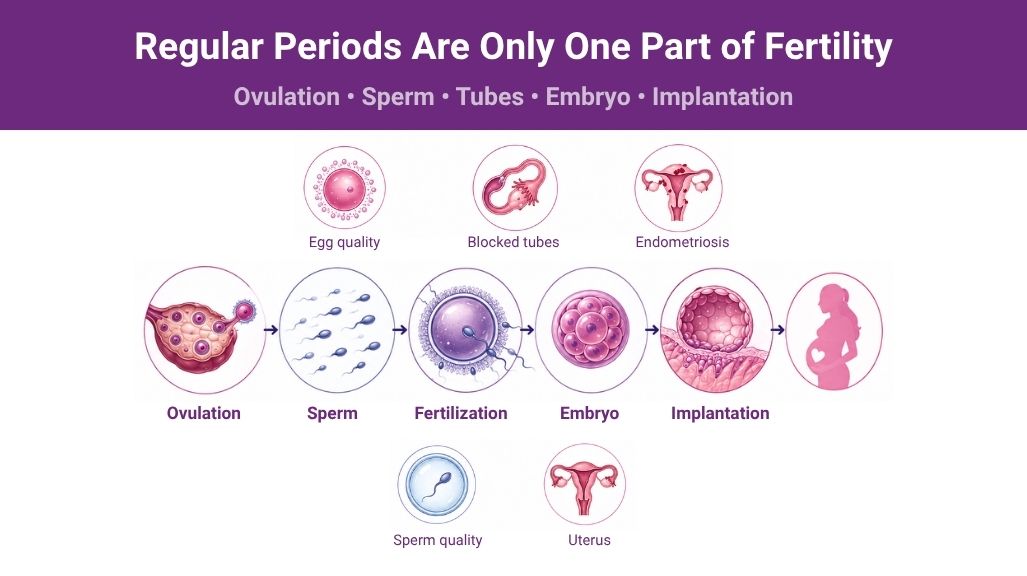
Pregnancy requires several steps to happen successfully: an egg needs to develop and ovulate, sperm must reach and fertilize the egg, the fallopian tubes must allow the egg and sperm to meet, and the resulting embryo must implant in the uterus.
Therefore, if you have regular periods but are not getting pregnant, other factors such as age, egg quality, sperm health, blocked fallopian tubes, endometriosis, uterine conditions, timing of intercourse, or unexplained infertility may need to be evaluated.
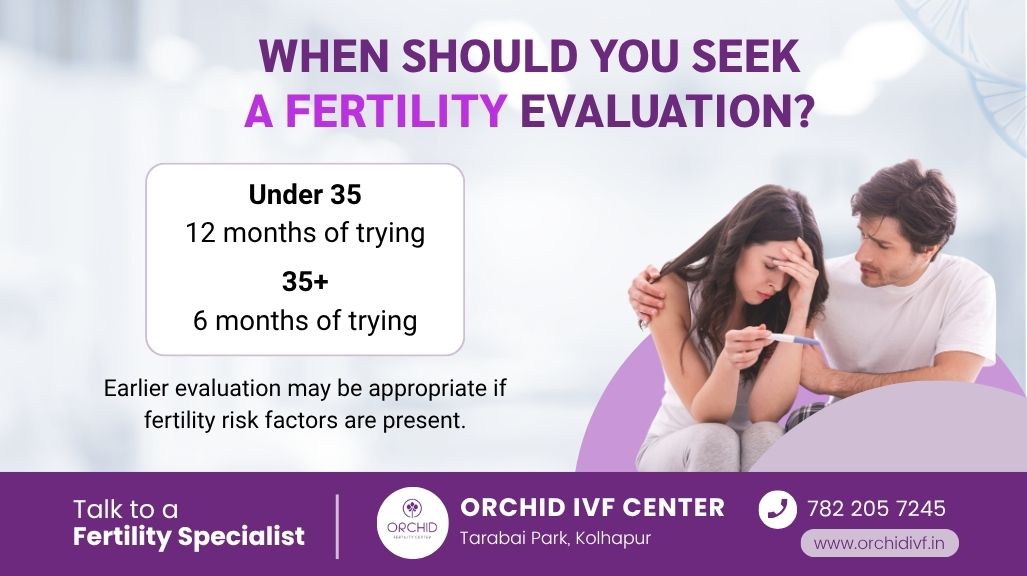
For women under 35, fertility evaluation is generally recommended after 12 months of regular unprotected intercourse without pregnancy. For women aged 35 or older, evaluation is generally recommended after 6 months; earlier evaluation may be appropriate when there are known fertility-related conditions or risk factors.
Does Having Regular Periods Mean I Am Fertile?
✕ Not necessarily.
A regular menstrual cycle is useful information when assessing fertility, and cycles that are generally regular and predictable are commonly associated with ovulation. However, fertility depends on much more than ovulation alone.
For pregnancy to occur, several factors need to work together
Ovulation → Egg quality → Sperm quality → Fertilization → Embryo development → Implantation
A problem at any of these stages can make conception difficult.
That is why a woman can have regular periods and still experience infertility.
7 Possible Reasons You Are Not Getting Pregnant Despite Regular Periods
1. Age and Egg Quality
One of the most important factors affecting female fertility is age.
You may continue to have regular periods while the number and quality of eggs gradually change with age.
Egg quality is particularly important because a healthy pregnancy requires an embryo capable of normal development.
This means:
Regular periods ≠ guaranteed good egg quality.
Age should therefore be considered as part of a complete fertility assessment rather than looking at menstrual regularity alone.
2. Sperm-Related Fertility Factors
Fertility is not only a female issue.
A couple may have regular menstrual cycles and still experience difficulty conceiving because of male-factor infertility.
Sperm-related factors can include:
- Low sperm count
- Reduced sperm motility
- Abnormal sperm morphology
- Other sperm function problems
A semen analysis is therefore an important part of fertility evaluation.
Current fertility guidance recommends evaluating the male partner alongside the female partner rather than investigating only the woman.
3. Blocked or Damaged Fallopian Tubes
Your ovaries may release eggs regularly, but the egg still needs to travel through the fallopian tube.
If the tubes are blocked or damaged, the sperm and egg may not be able to meet.
Possible causes include:
- Previous pelvic infections
- Previous pelvic surgery
- Endometriosis
- Previous ectopic pregnancy
- Other tubal conditions
A fertility specialist may recommend tests such as an HSG (Hysterosalpingogram) or another appropriate tubal assessment to check whether the fallopian tubes are open.
4. Endometriosis
Endometriosis occurs when tissue similar to the lining of the uterus grows outside the uterus.
It can sometimes affect fertility even when menstrual cycles are regular.
Depending on the individual, endometriosis may be associated with:
- Pelvic pain
- Painful periods
- Pain during intercourse
- Difficulty conceiving
However, not everyone with endometriosis has obvious symptoms.
If there is a history or suspicion of endometriosis, a fertility specialist may consider it as part of the overall evaluation.
5. Uterine or Endometrial Problems
Even when ovulation and fertilization occur, the embryo needs a suitable environment for implantation.
Certain uterine conditions may interfere with conception or pregnancy, including:
- Uterine polyps
- Certain fibroids
- Uterine abnormalities
- Adhesions or scar tissue
Depending on your history and symptoms, your doctor may recommend an ultrasound or other evaluation of the uterus.
6. Timing of Intercourse May Be Off
Having regular periods makes it easier to estimate the fertile window, but conception still depends on timing.
The fertile window is limited, and the chance of pregnancy is highest when intercourse occurs during the days leading up to ovulation and around ovulation.
If you are trying to conceive, understanding your cycle and identifying the fertile window can help.
Ovulation predictor kits, cycle tracking, or medical ovulation monitoring may be useful depending on your circumstances.
7. Unexplained Infertility
Sometimes all the standard fertility investigations appear normal, yet pregnancy still does not occur. If your routine fertility tests are normal but pregnancy has not occurred, you may also find it helpful to read about why you may not be getting pregnant despite normal reports.
This is commonly referred to as unexplained infertility.
It does not mean that there is no biological reason.
Rather, it means that currently available routine investigations have not identified a clear cause.
Further management depends on factors such as:
- Age
- Duration of infertility
- Previous pregnancies
- Ovarian reserve
- Sperm results
- Tubal status
- Previous treatment
Regular Periods but No Pregnancy: What Could Be the Reason?
✓ If This Is Normal…
Regular periods
Ovulation appears normal
Hormone reports are normal
Ultrasound looks normal
Periods are predictable
Fertile window is tracked
? There Could Still Be…
Egg quality concerns
Sperm-related factors
Blocked fallopian tubes
Endometriosis
Uterine factors
Unexplained infertility
The important point is that fertility is a couple’s health issue, not simply a menstrual-cycle issue.
What Tests May Be Needed?
There is no single fertility test that can answer why pregnancy has not occurred.
A fertility specialist may assess both partners and consider:
For the Woman
- Menstrual and fertility history
- Ovulation assessment when clinically indicated
- Ovarian reserve assessment
- Pelvic ultrasound
- Fallopian tube assessment
- Uterine evaluation
For the Male Partner
- Semen analysis
- Medical and reproductive history
- Further evaluation if abnormalities are identified
The exact tests should be selected according to the couple’s age, history, symptoms and previous results rather than ordering every available test routinely.
When Should You See a Fertility Specialist?
If You Are Under 35
If you have been having regular unprotected intercourse for 12 months without pregnancy, it is generally appropriate to seek a fertility evaluation.
If You Are 35 or Older
Consider an evaluation after 6 months of trying without pregnancy.
You May Need Earlier Evaluation If:
- You have known endometriosis
- You have had previous pelvic surgery
- You have experienced recurrent pregnancy loss
- There is a known male fertility issue
- You have a history that may affect ovarian reserve
- You have other known fertility-related conditions
- You have experienced recurrent pregnancy loss”: “If you have experienced repeated pregnancy loss, learn more about Recurrent Miscarriage Treatment.
Earlier assessment can help avoid unnecessary delays.
Do Regular Periods Mean I Don’t Need IVF?
No.
Having regular periods does not automatically mean that IVF is needed, and it also does not mean that IVF will be unnecessary.
The appropriate treatment depends on the reason pregnancy has not occurred. Learn more about IVF treatment to understand how this treatment may be considered when other fertility factors are involved.
The appropriate treatment depends on the reason pregnancy has not occurred.
Depending on the findings, treatment may include:
- Timed intercourse
- Ovulation monitoring
- Fertility medications
- IUI (Intrauterine Insemination)
- IVF (In Vitro Fertilization)
The aim should be to identify the most appropriate treatment rather than choosing IVF simply because pregnancy has not happened.
What Should You Do If You Have Regular Periods but Are Not Conceiving?
Start with a couple-based fertility evaluation rather than assuming the problem is with the menstrual cycle.
A fertility specialist may review:
- Your age
- How long you have been trying
- Menstrual and ovulation history
- Previous pregnancies
- Ovarian reserve
- Fallopian tube health
- Uterine health
- Your partner’s semen analysis
- Previous fertility treatments
For answers to common fertility questions, visit our Fertility FAQs.
🔑 Key Takeaways
● Regular periods are a positive sign, but they do not guarantee fertility.
● Pregnancy requires successful ovulation, fertilization, embryo development and implantation.
● Male-factor infertility can occur even when the woman’s cycles are completely regular.
● Blocked tubes, endometriosis, uterine conditions and egg-quality changes may affect conception.
● Timing intercourse around the fertile window can improve the opportunity for natural conception.
● If pregnancy has not occurred after 12 months under age 35 or 6 months at age 35 or older, consider a fertility evaluation.
● Both partners should be evaluated when appropriate.
For more information about fertility, conception and treatment options, explore our Fertility and IVF Articles.
About Orchid IVF Center, Kolhapur
If you have regular periods but are still struggling to conceive, you do not have to assume that something is seriously wrong.
A detailed fertility evaluation can help identify possible factors affecting conception and determine what treatment, if any, may be appropriate.
Orchid IVF Center, Kolhapur provides fertility evaluation and assisted reproductive care under the guidance of:
✓ Dr. Pooja Ghorpade
MD (Obstetrics & Gynecology) | IVF Consultant
Trained at I.V.F. N.U.H., Singapore
Contact Orchid IVF Center
📍 202, Second Floor, Eternity Square,
Opp. RTO Office,
Tarabai Park, Kolhapur
Frequently Asked Questions About Fertility Issues
1. Can I have regular periods and still be infertile? ▼
Yes. Regular periods often indicate a regular menstrual pattern, but fertility also depends on egg quality, sperm health, fallopian tubes, the uterus, fertilization and implantation.
2. Why am I not getting pregnant if I ovulate regularly? ▼
Regular ovulation is only one part of conception. Other factors such as sperm quality, blocked fallopian tubes, endometriosis, egg quality or uterine factors may affect pregnancy.
3. Should my husband also have fertility testing? ▼
Yes. Fertility evaluation should consider both partners because male factors can contribute to difficulty conceiving.
4. Can blocked fallopian tubes cause infertility despite regular periods? ▼
Yes. Regular periods and ovulation can occur even when one or both fallopian tubes are blocked.
5. Can endometriosis cause infertility with regular periods? ▼
Yes. Endometriosis can affect fertility even when menstrual cycles are regular.
6. When should I see a fertility specialist if my periods are regular? ▼
Generally, evaluation is recommended after 12 months of trying if you are under 35, and after 6 months if you are 35 or older. Earlier evaluation may be appropriate if you have known fertility risk factors.
