

Reviewed by
Dr. Pooja Ghorpade
MD (Obstetrics & Gynecology) | IVF Consultant
Specialized IVF Training – National University Hospital (NUH), Singapore
19+ Years of Experience in Women’s Health & Fertility Care
Quick Answer:
A low AMH level does not automatically mean that you cannot become pregnant. AMH, or Anti-Müllerian Hormone, is primarily used as an indicator of ovarian reserve, which refers to the remaining supply of eggs in the ovaries. However, AMH alone cannot tell you whether you can or cannot conceive naturally. Your chances of pregnancy depend on several factors, including age, egg quality, ovulation, sperm health, fallopian tube function, uterine health and how long you have been trying to conceive.
If you have been told that you have low AMH, the result should be interpreted in the context of your complete fertility evaluation rather than viewed in isolation.
What Is AMH?
AMH stands for Anti-Müllerian Hormone.
It is produced by small follicles in the ovaries and is commonly used as one of the markers of ovarian reserve.
In simple terms:
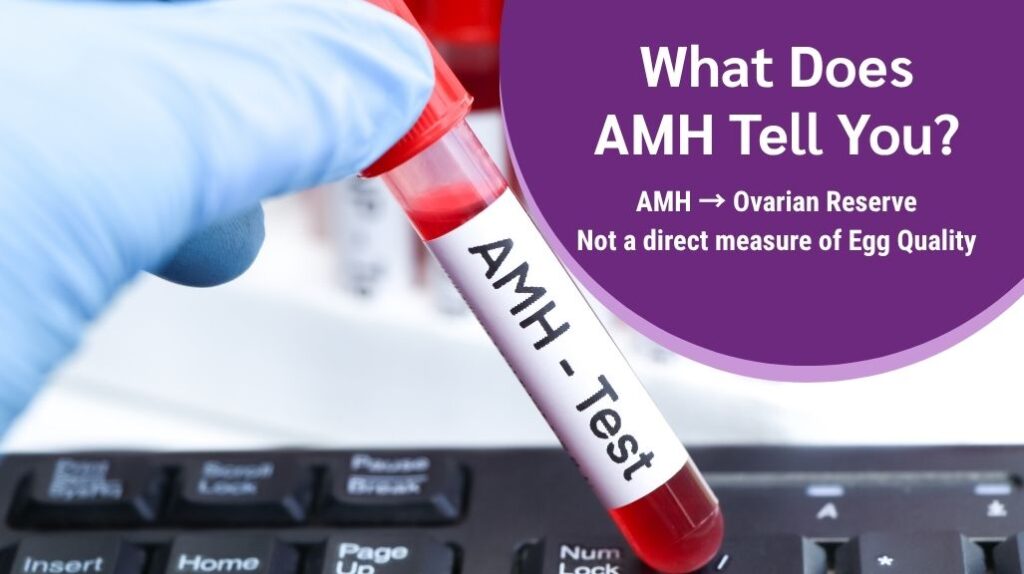
AMH can give an indication of egg quantity, but it does not directly measure egg quality.
This distinction is very important.
A woman with low AMH may still have eggs capable of fertilization and pregnancy.
Similarly, a normal AMH level does not guarantee pregnancy.
What Does Low AMH Actually Mean?
Low AMH generally suggests that the number of eggs remaining in the ovaries may be lower than expected for the woman’s age.
It may also mean that the ovaries could produce fewer eggs in response to fertility stimulation.
However, low AMH does not necessarily mean:
- You cannot ovulate
- You cannot conceive naturally
- Your eggs are all poor quality
- You definitely need IVF
- Pregnancy is impossible
This is why an AMH result should always be interpreted by a fertility specialist alongside other clinical information.
Yes, Natural Pregnancy Can Still Be Possible
A woman with low AMH may continue to ovulate and can potentially conceive naturally.
The important question is not simply:
“What is my AMH level?”
Instead, your fertility specialist will consider:
- Your age
- Whether you are ovulating
- Your menstrual history
- Your ovarian reserve
- Your partner’s sperm health
- Fallopian tube health
- Uterine health
- Duration of infertility
For some women, natural conception may still be reasonable.
For others, particularly when age or other fertility factors are involved, delaying treatment may not be advisable.
Low AMH vs Egg Quality: Are They the Same?
No.
This is one of the most important things to understand about AMH.
| AMH | What It Tells Us |
|---|---|
| Low AMH | May indicate reduced ovarian reserve |
| Normal AMH | May indicate an expected ovarian reserve |
| AMH | Does not directly measure egg quality |
| AMH | Does not guarantee natural pregnancy |
| AMH | Does not predict pregnancy by itself |
Egg quality is strongly influenced by age, among other biological factors.
Therefore, a fertility specialist should not make treatment decisions based only on an AMH number.
Why Does AMH Matter in Fertility Treatment?
AMH can be useful when planning fertility treatment because it may help doctors estimate how the ovaries could respond to stimulation.
For example, it can help with:
- Planning an IVF stimulation protocol
- Estimating the likely ovarian response
- Discussing fertility preservation
- Assessing ovarian reserve along with other tests
However, AMH is only one part of the assessment.
An antral follicle count (AFC) on ultrasound may also be considered when evaluating ovarian reserve.
What Causes Low AMH?
AMH naturally varies between women and tends to decline with age.
Factors associated with reduced ovarian reserve may include:
Age
Ovarian reserve naturally decreases over time.
Previous Ovarian Surgery
Certain ovarian procedures may affect ovarian reserve.
Some Medical Treatments
Certain cancer treatments, for example, can affect ovarian function.
Certain Ovarian Conditions
Some medical conditions may be associated with reduced ovarian reserve.
However, sometimes AMH is simply lower than expected without an obvious cause.
Not automatically.
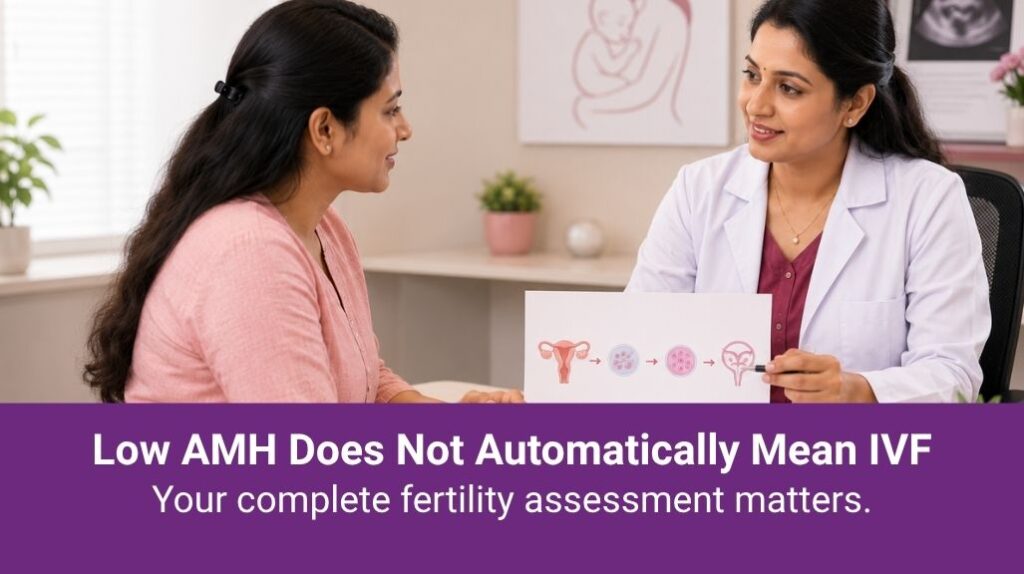
Low AMH does not by itself determine whether IVF is necessary.
A fertility specialist may consider IVF when low ovarian reserve is combined with factors such as:
- Increasing age
- Difficulty conceiving for a prolonged period
- Previous unsuccessful fertility treatment
- Other female fertility factors
- Male-factor infertility
- Blocked fallopian tubes
- A need to maximize the opportunity for pregnancy sooner
The treatment decision should be individualized.
When Might IVF Be Considered With Low AMH?
IVF may be considered when the overall fertility assessment suggests that moving to assisted reproduction could provide a better or more timely opportunity for pregnancy.
For example, your doctor may discuss IVF if you have:
Low AMH + Age-Related Fertility Decline
Age affects both ovarian reserve and egg quality.
Low AMH + Previous Failed Treatment
If previous fertility treatment has not resulted in pregnancy, IVF may be discussed.
Low AMH + Male-Factor Infertility
If there is also a significant sperm-related issue, IVF with appropriate fertilization techniques may be considered.
Low AMH + Tubal Problems
If fallopian tubes are blocked, IVF can bypass the tubes.
Does Low AMH Mean IVF Will Not Work?
No.
A low AMH level can indicate that fewer eggs may be available for stimulation, but it does not mean that IVF cannot result in pregnancy.
IVF success depends on several factors.
These include:
- Age
- Number and quality of eggs retrieved
- Sperm quality
- Embryo development
- Uterine health
- Overall reproductive health
The response to ovarian stimulation can also vary considerably between individuals.
Can Low AMH Be Increased Naturally?
There is no proven lifestyle treatment that can reliably restore ovarian reserve or significantly increase the number of eggs remaining in the ovaries.
However, maintaining overall health is still important.
You can support your general reproductive health by:
- Maintaining a healthy weight
- Eating a balanced diet
- Exercising regularly
- Avoiding smoking
- Limiting alcohol
- Managing medical conditions
- Getting adequate sleep
Be cautious about supplements or “AMH-boosting” treatments promoted online. Speak to a fertility specialist before taking supplements specifically for fertility.
What Tests Are Usually Considered With AMH?
AMH should not be interpreted alone.
Depending on your situation, your fertility specialist may consider:
AMH Blood Test
Provides information about ovarian reserve.
Antral Follicle Count
An ultrasound can assess the number of small follicles visible in the ovaries.
FSH and Other Hormonal Tests
These may be considered depending on the clinical situation.
Pelvic Ultrasound
Can evaluate the ovaries and uterus.
Ovulation Assessment
Helps determine whether eggs are being released.
Semen Analysis
The male partner should also be evaluated because fertility involves both partners.
Fallopian Tube Assessment
Tests such as HSG may be recommended when clinically appropriate.
Low AMH: What Should You Do Next?
If you have received a low AMH result, don’t panic and don’t make treatment decisions based on the number alone.
A sensible next step is to discuss the result with a fertility specialist.
Your doctor may consider:
Together, these factors provide a much clearer picture than AMH alone.
Consider a fertility evaluation if:
- You have been trying to conceive without success
- You have been told that your AMH is low
- You are planning pregnancy at an older age
- You have irregular or absent periods
- You have a history of ovarian surgery
- You have previously undergone chemotherapy or radiation
- You have experienced repeated pregnancy loss
- Your partner has a known fertility problem
If you are concerned about your ovarian reserve, early discussion with a fertility specialist can help you understand your options before valuable time is lost.
Low AMH Does Not Mean No Hope
Being told that you have low AMH can be frightening.
But it is important to remember:
Low AMH is a fertility marker, not a verdict on your ability to become a mother.
Some women with low AMH conceive naturally. Others may need fertility treatment.
The right approach depends on the complete fertility picture.
The most important step is understanding your individual situation rather than comparing your AMH level with someone else’s.
Key Takeaways
- Pregnancy is possible with low AMH.
- Low AMH generally indicates reduced ovarian reserve.
- AMH does not directly measure egg quality.
- AMH alone cannot predict whether you will become pregnant.
- Age is an important factor when interpreting ovarian reserve and fertility.
- Some women with low AMH conceive naturally.
- IVF may be considered when low ovarian reserve is combined with other fertility factors or when time is important.
- Both partners should be evaluated when appropriate.
- A personalized fertility assessment is more useful than focusing on one test result.
About Orchid IVF Center, Kolhapur
If you have been told that your AMH is low, you may have many questions about your chances of pregnancy and whether you need fertility treatment.
At Orchid IVF Center, Kolhapur, fertility evaluation is based on the complete clinical picture rather than a single test result.
Dr. Pooja Ghorpade
MD (Obstetrics & Gynecology) | IVF Consultant
Trained at I.V.F. N.U.H., Singapore
For personalized fertility guidance:
Contact Orchid IVF Center
202, Second Floor, Eternity Square, Opp. RTO Office, Tarabai Park, Kolhapur