

Couples often wonder “When is IVF considered?” and whether they should try other fertility treatments first. Understanding the full range of IVF treatment options and fertility treatment options can help you make an informed decision about the next step in your fertility journey.
At Orchid IVF Kolhapur, we evaluate each couple individually. IVF is not always the first treatment recommended, but it can be an effective option when other treatments are unlikely to succeed or have already been unsuccessful.
What Are IVF Treatment Options?
IVF treatment options include several approaches depending on the cause of infertility:
| Treatment Option | When It May Be Used |
|---|---|
| Conventional IVF | General infertility treatment |
| IVF with ICSI | Male factor infertility |
| Frozen embryo transfer | Use of previously frozen embryos |
| Donor egg IVF | Severely reduced egg reserve |
| Donor sperm IVF | Severe male infertility |
| Embryo freezing | Future pregnancy planning |
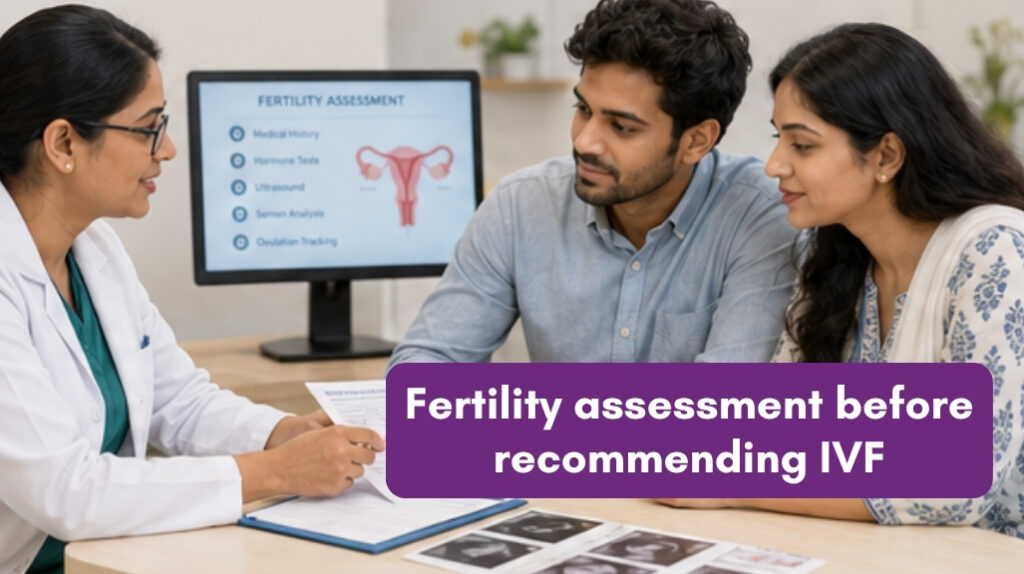
This pathway helps fertility specialists choose the most appropriate treatment rather than immediately recommending IVF.
What Are Fertility Treatment Options Before IVF?
Many couples start with simpler fertility treatment options before IVF.
Ovulation Induction
Used for irregular ovulation or PCOS.
Timed Intercourse
Planned around ovulation.
IUI (Intrauterine Insemination)
Often recommended for mild infertility.
Low Sperm Count Treatment
Lifestyle changes, medications, or surgical evaluation when appropriate.
Treatment of Hormonal or Medical Conditions
Such as thyroid disorders or elevated prolactin levels.
Such as thyroid disorders or elevated prolactin levels.
When Is IVF Considered?
IVF may be considered when:
- Fallopian tubes are blocked or damaged
- Severe male factor infertility is present
- Multiple IUI cycles have failed
- Unexplained infertility has persisted for a long time
- Advanced maternal age reduces natural fertility
- Endometriosis significantly affects fertility
- Fertility preservation or embryo freezing is planned
Comparison Table: IUI vs IVF
| Feature | IUI | IVF |
|---|---|---|
| Complexity | Lower | Higher |
| Cost | Lower | Higher |
| Egg retrieval | No | Yes |
| Fertilization location | Inside the body | In the laboratory |
| Suitable for severe male infertility | Limited | Yes |
| Embryo freezing possible | No | Yes |
How IVF Treatment Is Done
1. Ovarian stimulation
Hormone injections help multiple eggs mature.
2.Monitoring
Ultrasound scans and blood tests track egg development.
3.Egg retrieval
Mature eggs are collected from the ovaries.
4.Fertilization
Eggs are fertilized with sperm in the laboratory.
5.Embryo development
Embryos are monitored for several days.
6.Embryo transfer
A selected embryo is placed into the uterus.
7.Pregnancy test
Usually performed about two weeks later.
What Is IVF Treatment Pregnancy?
IVF treatment pregnancy refers to a pregnancy achieved after an embryo created through IVF implants successfully in the uterus and continues to develop normally.
Once implantation occurs, the pregnancy progresses similarly to a naturally conceived pregnancy, although fertility specialists may provide additional early monitoring.
What Is Frozen Embryo Transfer?
Frozen embryo transfer (FET) is a procedure in which an embryo that was previously frozen during an IVF cycle is thawed and transferred into the uterus.
FET may be recommended when:
- Extra embryos were frozen
- A previous IVF cycle did not result in pregnancy
- The uterine lining is better prepared in a later cycle
- Fertility preservation was performed earlier
Comparison Table: Fresh Embryo Transfer vs Frozen Embryo Transfer
| Feature | Fresh Transfer | Frozen Transfer |
|---|---|---|
| Timing | Same IVF cycle | Later cycle |
| Embryo freezing | No | Yes |
| Uterine preparation | Immediate | Planned separately |
| Use of stored embryos | No | Yes |
| Additional flexibility | Less | More |
Who Should Consider IVF Treatment Options?
You may benefit from discussing IVF if:
- You are over 35 and have been trying for 6 months or more
- You have blocked fallopian tubes
- You have severe endometriosis
- You have severe male factor infertility
- You have failed multiple IUI cycles
- You have long-standing unexplained infertility
Top Benefits of IVF Treatment Options
Bypass Blocked Tubes
Can bypass blocked fallopian tubes
Treat Severe Male Infertility
Can help treat severe male infertility
Embryo Freezing
Allows embryo freezing for future use
Control Over Fertilization
Provides greater control over fertilization
Multiple Pregnancy Opportunities
May offer multiple pregnancy opportunities from a single egg retrieval
Cost Factors for IVF Treatment
| Component | May Affect Cost |
|---|---|
| Consultation | Specialist experience |
| Stimulation medications | Dosage required |
| Egg retrieval procedure | Clinical protocol |
| ICSI | Additional laboratory procedure |
| Embryo freezing | Storage duration |
| Frozen embryo transfer | Separate treatment cycle |
Timeline: How Long Does IVF Take?
| Stage | Approximate Time |
|---|---|
| Initial evaluation | 1–2 weeks |
| Ovarian stimulation | 10–14 days |
| Egg retrieval | 1 day |
| Embryo culture | 3–5 days |
| Embryo transfer | Same cycle or later |
| Pregnancy test | About 14 days after transfer |
Patient Journey: Example Case Study
Mr. & Mrs. A, 36 & 38 years
Illustrative example
Challenge
Three unsuccessful IUI cycles and long-standing unexplained infertility.
Evaluation
Age-related decline in fertility was suspected despite largely normal routine reports.
Treatment
IVF with embryo freezing, followed by frozen embryo transfer.
Outcome
Successful implantation and ongoing pregnancy.
People Also Ask
How IVF treatment is done?
IVF involves ovarian stimulation, egg retrieval, laboratory fertilization, embryo culture, embryo transfer, and a pregnancy test.
What is frozen embryo transfer?
It is the transfer of a previously frozen embryo into the uterus during a later treatment cycle.
What is IVF treatment pregnancy?
It is a pregnancy achieved after an embryo created through IVF successfully implants and develops in the uterus.
What are fertility treatment options before IVF?
Ovulation induction, timed intercourse, IUI, hormonal treatment, and low sperm count treatment may be considered first.
When is IVF considered?
IVF is often considered when simpler treatments fail, tubes are blocked, severe male infertility is present, or age-related fertility decline is significant.
Frequently Asked Questions About IVF

Conclusion: Choosing the Right IVF Treatment Option
IVF treatment options are part of a broader range of fertility treatment options available to couples facing infertility. The right choice depends on age, duration of infertility, sperm health, tubal status, previous treatments, and individual reproductive goals.
Whether you are exploring low sperm count treatment, considering frozen embryo transfer, or trying to understand how IVF treatment is done, a personalized fertility evaluation can help determine the most effective path forward.
At Orchid IVF Kolhapur, we guide couples through every stage of treatment planning with evidence-based recommendations and individualized care.
Contact Orchid IVF Center
202, Second Floor, Eternity Square,
Opp. RTO Office,
Tarabai Park, Kolhapur